Agentic Coding Workflow & Cline Demo

Square Peg hosted event on June 20, 2025 where I demonstrated a basic version of my daily Agentic Coding workflow using Cline and MCP tools. What does it take to write enterprise-grade code in the AI-native era? Join Square Peg investors James Tynan and Grace Dalla-Bona for a live demo and Q&A session with three leading AI-native developers - Grant Gurvis, Listiarso Wastuargo, and Sam McLeod - and get a behind-the-curtain look at the workflows that enable them to ship faster, smarter, and cleaner code using tools like Cursor, Cline, and smolagents. ...

June 20, 2025 · 1 min · 92 words · Sam McLeod

Vibe Coding vs Agentic Coding

Picture this: A business leader overhears their engineering team discussing “vibe coding” and immediately imagines developers throwing prompts at ChatGPT until something works, shipping whatever emerges to production. The term alone—“vibe coding”—conjures images of seat-of-the-pants development that would make any CTO break out in a cold sweat. This misunderstanding is creating a real problem. Whilst vibe coding represents genuine creative exploration that has its place, the unfortunate terminology is causing some business leaders to conflate all AI-assisted / accelerated development with haphazard experimentation. I fear that engineers using sophisticated AI coding agents be it with advanced agentic coding tools like Cline to deliver production-quality solutions are finding their approaches questioned or dismissed entirely. ...

June 6, 2025 · 7 min · 1422 words · Sam McLeod
Agentic Coding Development Flow

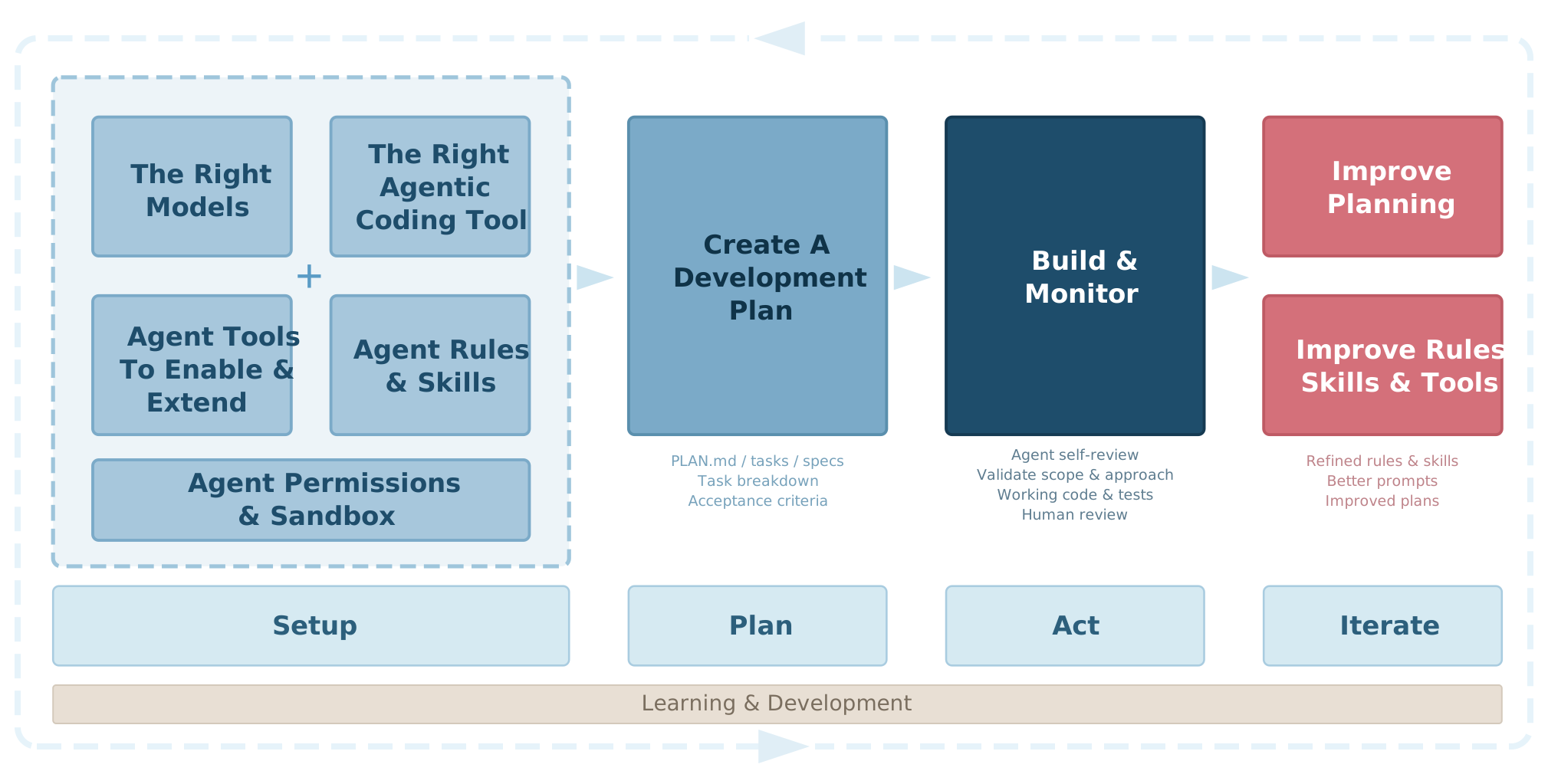
My Plan, Document, Act, Review flow for Agentic Software Development

I follow a simple, yet effective flow for agentic coding that helps me to efficiently develop software using AI coding agents while keeping them on track, focused on the task at hand and ensuring they have access to the right tools and information. The flow is simple: Setup -> Plan -> Act -> Review and Iterate. Workflow Quickstart Outline of Setup -> Plan -> Act -> Review & Iterate workflow: ...

April 28, 2025 · 11 min · 2314 words · Sam McLeod
LLM Sampling Methods Comparison

LLM Sampling Parameters Guide

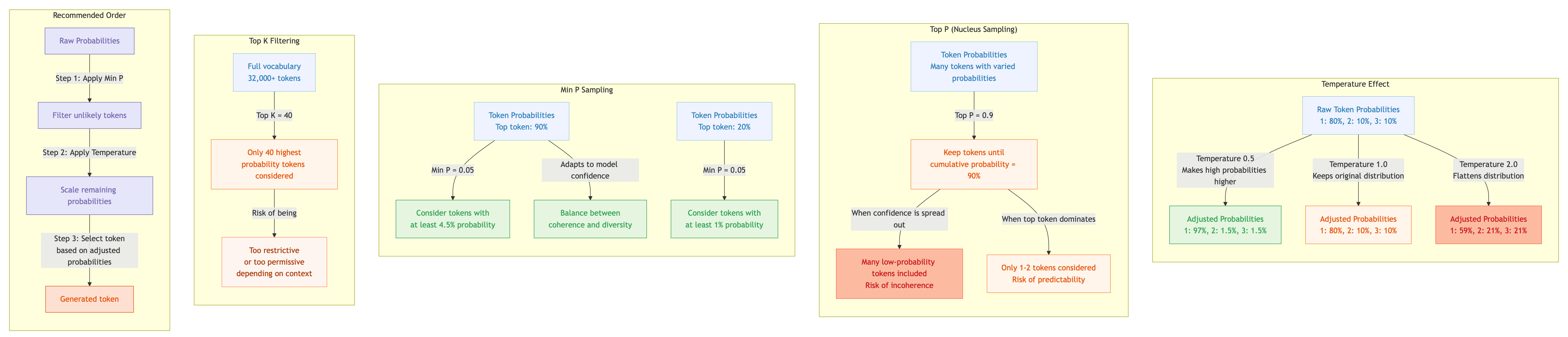
Large Language Models don’t generate text deterministically - they use probabilistic sampling to select the next token based on prediction probabilities. How these probabilities are filtered and adjusted before sampling significantly impacts output quality. This guide explains the key sampling parameters, how they interact, and provides recommended settings for different use cases. Framework Reference Last updated: November 2025 Parameter Comparison Parameter llama.cpp Default Ollama Default MLX Temperature temp 0.8 temperature 0.8 temp Top P top_p 0.9 top_p 0.9 top_p Min P min_p 0.1 min_p 0.0 min_p Top K top_k 40 top_k 40 top_k Repeat Penalty repeat_penalty 1.0 repeat_penalty 1.1 Unsupported Repeat Last N repeat_last_n 64 repeat_last_n 64 Unsupported Presence Penalty presence_penalty 0.0 presence_penalty - Unsupported Frequency Penalty frequency_penalty 0.0 frequency_penalty - Unsupported Mirostat mirostat 0 mirostat 0 Unsupported Mirostat Tau mirostat_ent 5.0 mirostat_tau 5.0 Unsupported Mirostat Eta mirostat_lr 0.1 mirostat_eta 0.1 Unsupported Top N Sigma top_nsigma -1.0 Unsupported - Unsupported Typical P typical_p 1.0 typical_p 1.0 Unsupported XTC Probability xtc_probability 0.0 Unsupported - xtc_probability XTC Threshold xtc_threshold 0.1 Unsupported - xtc_threshold DRY Multiplier dry_multiplier 0.0 Unsupported - Unsupported DRY Base dry_base 1.75 Unsupported - Unsupported Dynamic Temp dynatemp_range 0.0 Unsupported - Unsupported Seed seed -1 seed 0 - Context Size ctx_size 2048 num_ctx 2048 - Max Tokens n_predict -1 num_predict -1 - Notable Default Differences Parameter llama.cpp Ollama Note min_p 0.1 0.0 Ollama disables Min P by default repeat_penalty 1.0 1.1 Ollama applies penalty by default seed -1 (random) 0 Different random behaviour Feature Support Feature llama.cpp Ollama MLX Core (temp, top_p, top_k, min_p) ✓ ✓ ✓ Repetition penalties ✓ ✓ ✗ Presence/frequency penalties ✓ ✓ ✗ Mirostat ✓ ✓ ✗ Advanced (DRY, XTC, typical, dynatemp) ✓ ✗ Partial Custom sampler ordering ✓ ✗ ✗ Core Sampling Parameters Temperature Controls the randomness of token selection by modifying the probability distribution before sampling. ...
April 25, 2025 · 8 min · 1683 words · Sam McLeod
Generative Agent State Diagram

Getting Started with Agentic Systems - Developer Learning Paths

As agentic systems become increasingly central to modern software development, many engineers are looking to build practical skills but don’t know where to start. This guide provides a short list of pre-reading/watching and hands-on training resources to help you get started with developing with AI agents. The focus is on practical implementation for tools and methods you’re likely to use in the workplace, so you can quickly gain experience and confidence in building AI powered and agentic systems. ...

April 16, 2025 · 4 min · 680 words · Sam McLeod